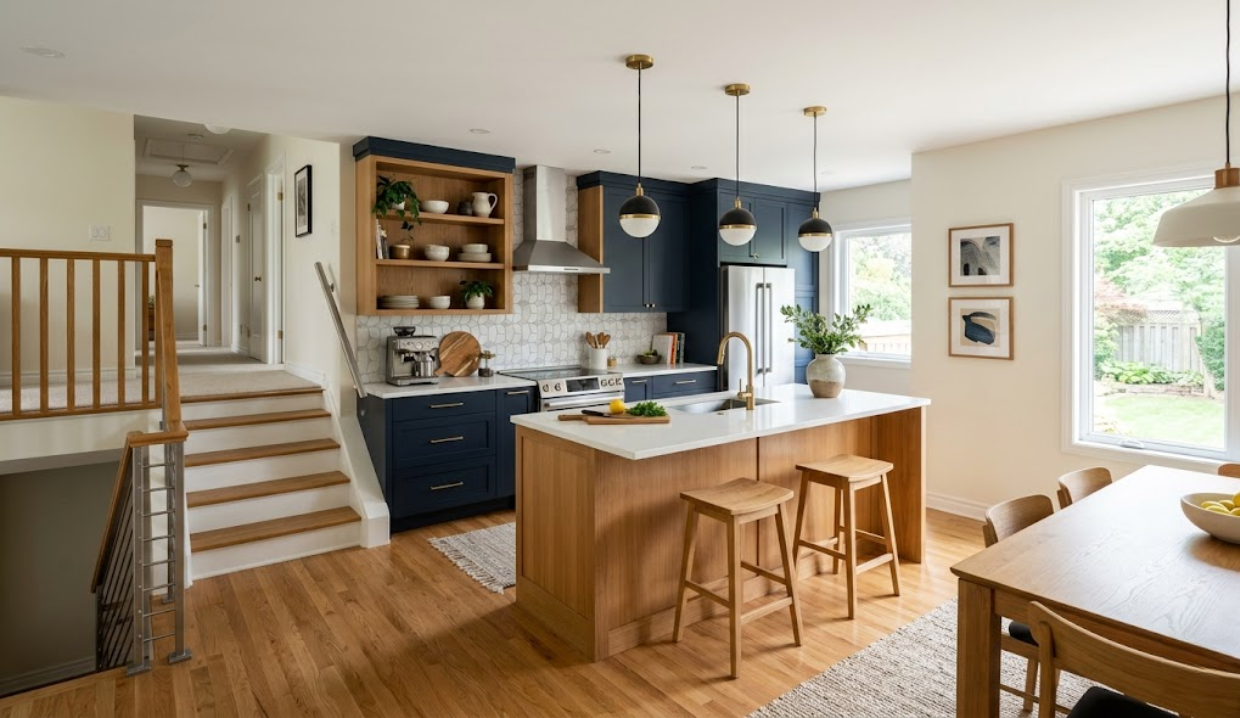
Split level homes often come with one frustrating design flaw: the kitchen feels disconnected, cramped, and visually broken from the rest of the living space. If you’ve ever stood in a split foyer kitchen and wondered why everything feels slightly off—tight corners, awkward transitions, limited light—you’re not imagining it. The layout itself creates those challenges.
The good news is that a split level kitchen renovation can completely change how the home feels. With the right structural planning, layout strategy, and design decisions, even a closed-off kitchen can become open, modern, and highly functional.
This guide breaks down everything from structure to design, costs, layout solutions, and the hidden details most homeowners overlook.
Understanding Split Level Kitchen Layout Constraints
Split level kitchens are shaped by the home’s staggered floor system. Instead of one continuous level, you typically have short flights of stairs separating living zones. The kitchen often sits between these levels, which limits expansion and creates unusual wall placements.
A split level kitchen design challenge usually comes from three things:
- Load-bearing walls that divide spaces
- Limited ceiling height flexibility
- Restricted natural light due to segmented floors
These constraints define how far you can push an open concept transformation.
In many raised ranch kitchen redesign projects, homeowners discover that what looks like a simple wall removal actually requires structural reinforcement. That’s where planning becomes critical.
Why Split Level Kitchens Feel Closed Off
There’s a reason these kitchens often feel dark or tight.
Older multi-level homes were designed for separation, not openness. Kitchens were placed in isolated zones to contain cooking noise and smells.
Common issues include:
- Narrow entry points into the kitchen
- Poor visual connection to dining or living areas
- Limited window placement
- Competing stair traffic flow near the cooking space
This creates what designers call “fragmented flow,” where movement feels interrupted instead of smooth.
Best Layout Strategies for Split Level Kitchen Renovation
A successful split level kitchen remodel starts with layout correction, not decoration.
Open Concept Conversion Approach
Removing unnecessary barriers is the most impactful change. However, in split level house kitchen layout change projects, you must first identify structural walls.
Once safe walls are confirmed for removal, the space can open toward:
- Dining areas
- Living rooms
- Entry transitions
This instantly improves flow and visibility.
Island Placement in Narrow Split Layouts
Adding a kitchen island in a split level home is possible, but only when spacing allows proper circulation.
A good rule is:
- Minimum 36–42 inches around all sides for movement
In compact split level kitchen design cases, a peninsula often works better than a full island.
Kitchen + Dining Integration Flow
Instead of treating the kitchen as a separate box, modern designs merge it with dining zones. This creates a unified cooking-eating space that improves usability and social interaction.
Structural Changes and Engineering Considerations
This is the most critical phase of any split level kitchen renovation.
Load-Bearing Wall Removal Process
Walls in split level homes often support upper-floor weight. Removing them without reinforcement can compromise the structure.
A safe approach includes:
- Structural inspection
- Load identification
- Temporary support installation
- Beam replacement (steel or LVL beams)
- Final finishing
This is why consulting a structural engineer is not optional in many cases.
Beam Installation and Support Systems
Once a wall is removed, beams redistribute weight. These can be hidden within ceiling lines or exposed as design features.
Proper beam placement allows a full open concept transformation without compromising safety.
Ceiling Height Limitations
Many split level kitchens have uneven ceiling levels due to staggered floors. Raising ceilings is possible, but expensive and dependent on the framing structure.
Sometimes, instead of raising ceilings, designers use:
- Vertical lighting
- Light-colored finishes
- Open shelving
to create the illusion of height.
Plumbing, Electrical, and HVAC Challenges
Kitchen renovations in split level homes are not just visual—they are technical.
Moving Kitchen Plumbing in Split Level Homes
Relocating sinks or dishwashers may require rerouting pipes through multiple levels. This increases labor complexity and cost.
Also read: How to Design Home Renovation Homenumental Guide
Electrical Rewiring for Modern Appliances
Older split level homes often lack sufficient circuits for:
- Induction cooktops
- Wall ovens
- Smart appliances
Upgrading electrical panels is common during renovation.
HVAC Rerouting in Multi-Level Homes
Air circulation is uneven in split level layouts. Kitchen renovations often include duct adjustments to improve temperature balance.
Design Solutions for Small and Awkward Spaces
Not every split level kitchen can be fully expanded. In many cases, smart design matters more than structural change.
Lighting Strategies for Split Level Kitchens
Lighting is the fastest way to improve perception of space.
Effective solutions include:
- Under-cabinet LED strips
- Ceiling recessed lighting
- Pendant lights over islands
- Natural light enhancement through window expansion
A well-lit kitchen instantly reduces the “closed-in” feeling.
Storage Optimization and Cabinetry Design
In tight layouts, every inch matters.
Smart options:
- Full-height cabinets
- Pull-out pantry systems
- Corner carousel storage
- Hidden appliance garages
Brands like IKEA offer modular systems that work well in compact kitchens, while custom cabinetry allows better use of irregular walls.
Flooring Transitions Between Levels
One overlooked issue in split level floor plan optimization is flooring mismatch.
Smooth transitions between the kitchen and adjacent spaces help unify the home visually. Continuous flooring materials, such as luxury vinyl or engineered wood, would reduce fragmentation.
Cost Breakdown and Budget Planning
Split level home kitchen remodeling costs vary widely depending on structural work.
Structural vs Cosmetic Renovation Costs
- Cosmetic update: cabinets, paint, fixtures
- Structural renovation: wall removal, beams, plumbing changes
Structural work can significantly increase the budget due to engineering requirements.
Permit and Engineering Expenses
Most open concept conversion projects require:
- Structural permits
- Engineering reports
- Inspection fees
Ignoring these can lead to compliance issues later.
Modern Kitchen Design Styles for Split Level Homes
Design style plays a big role in how spacious the kitchen feels after renovation.
Minimalist Modern Layouts
Clean lines, handleless cabinets, and neutral tones work best in compact split level kitchens.
Scandinavian-Inspired Kitchens
Light wood finishes and bright surfaces help counteract the darker layouts typical in older homes.
High-End Compact Kitchens
Premium materials from brands like Caesarstone or Silestone elevate small kitchens without overcrowding the space.
Appliance integration using compact systems from Bosch or smart kitchen technology from Samsung improves functionality without sacrificing space.
Tools and Planning for Split Level Kitchen Renovation
Before construction begins, proper visualization is essential.
Many designers rely on tools like:
- SketchUp for 3D layout testing
- AutoCAD for technical planning
Platforms such as Houzz help homeowners explore real renovation examples and design inspiration.
Common Mistakes in Split Level Kitchen Renovations
Many projects fail not because of design, but because of poor planning.
Ignoring Structural Load Paths
Removing walls without analysis can cause serious structural issues.
Poor Lighting Planning
Even a beautifully renovated kitchen will feel small if the lighting is weak.
Overcrowding Small Layouts
Adding too many features in a compact kitchen reduces movement and usability.
Forgetting Traffic Flow
Split level homes often have stair access near the kitchens. Poor planning leads to congestion during daily use.
FAQS: Split level house kitchen renovations
How do you modernize a split level kitchen layout?
Start with layout openness, improve lighting, and remove unnecessary partitions where structurally safe. Then upgrade storage and appliances for efficiency.
Can you open up a split level kitchen safely?
Yes, but only after confirming which walls are load-bearing and reinforcing them with beams when needed.
What is the best layout for split level kitchens?
An open concept layout with clear zones for cooking, dining, and movement works best.
How do you add an island to a split level kitchen?
Ensure proper clearance on all sides or use a peninsula if space is limited.
Conclusion: Turning a Split Level Kitchen Into a Modern Living Space
A split level kitchen renovation is not just a design upgrade—it is a structural transformation. The biggest results come from combining engineering decisions with smart spatial planning.
When done correctly, the kitchen shifts from a closed, segmented room into the central hub of the home. Open flow, better lighting, and functional zoning completely change how the space is experienced.
The key is simple: respect the structure, optimize the layout, and design for movement first. Everything else builds from there.