Adding an accessory dwelling unit (ADU) in California is one of the most effective ways to increase property value and create flexible living space. But when it comes to the kitchen, most homeowners run into confusion around California ADU kitchen requirements. What exactly is required? Do you need a full kitchen, or is a kitchenette enough? And how strict are California inspectors?
The answer is more detailed than most people expect. California law doesn’t just define “a kitchen” in simple terms—it ties it to habitability standards, energy codes, plumbing rules, and local zoning enforcement. Understanding these requirements early can save you from costly redesigns, permit delays, or inspection failures.
This guide breaks everything down clearly so you can design a compliant, efficient ADU kitchen without guesswork.
What Counts as a Legal ADU Kitchen in California
A legal ADU kitchen in California is not just a space with appliances—it must meet specific habitability and building code standards that define it as a fully functional independent living unit.
In simple terms:
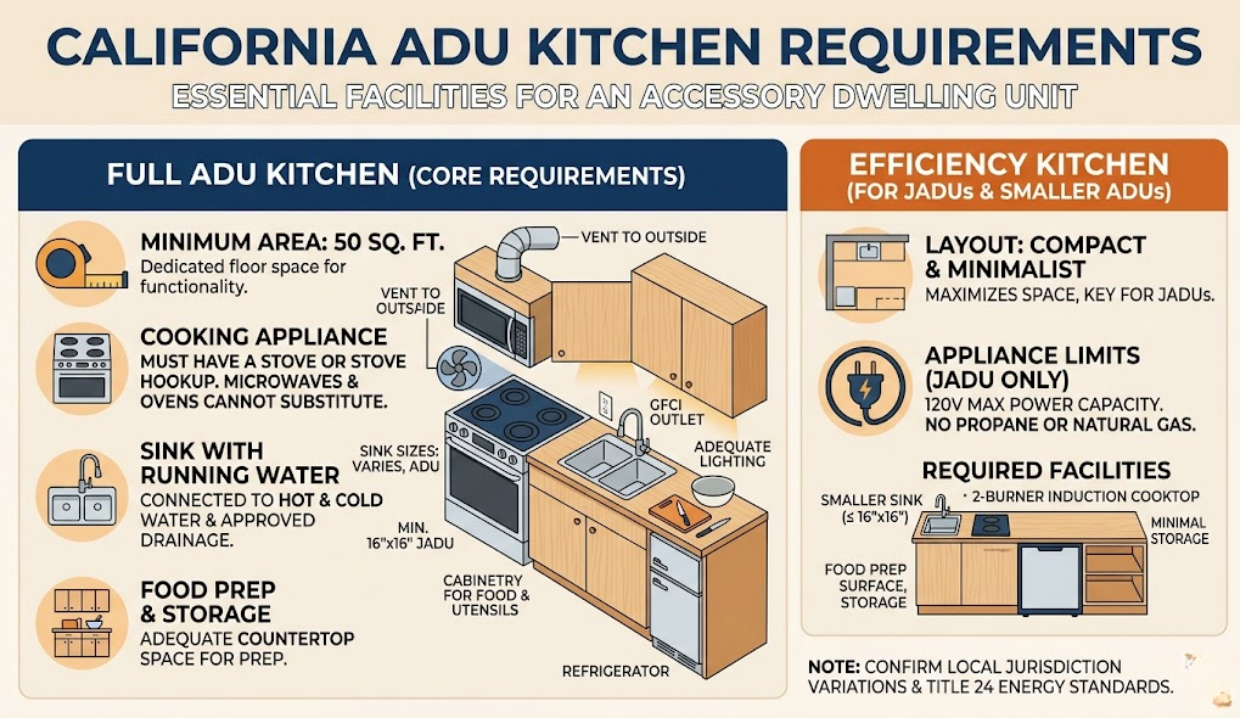
A compliant ADU kitchen must include cooking capability, food preparation space, and basic kitchen infrastructure such as a sink, power supply, and proper ventilation, all approved under California Building Code requirements.
The state distinguishes between:
- A full kitchen (standard ADU requirement)
- A limited kitchenette (sometimes allowed in Junior ADUs)
The key difference is independence. A legal ADU must support long-term living without reliance on the main house.
Kitchen vs kitchenette definition
- Full kitchen: Includes a stove or cooktop, sink, refrigerator space, countertops, and permanent plumbing/electrical systems.
- Kitchenette: A simplified setup, often allowed in Junior ADUs, with limited cooking features and shared utility constraints.
Most standard ADUs require a full kitchen unless local exceptions apply.
California Building Code Requirements for ADU Kitchens
California’s building rules are enforced through the California Building Code (CBC) and local zoning ordinances. These rules ensure safety, energy efficiency, and habitability.
Key compliance areas include:
- Minimum functional kitchen setup for independent living
- Proper spacing and layout for safe movement
- Structural safety for installed appliances
- Permanent installation (not temporary setups)
The California Department of Housing and Community Development (HCD) plays a major role in standardizing ADU approvals across counties, but local cities still interpret enforcement differently.
This is why two similar ADU kitchens can receive different inspection outcomes depending on location.
Appliance Requirements for ADU Kitchens
California does not explicitly require luxury appliances, but it does require functional cooking capability.
Essential appliance expectations:
- A fixed cooking device (stove, cooktop, or approved alternative)
- Refrigerator space (built-in or designated area)
- Permanent sink with hot and cold water access
Induction cooktops are widely accepted as long as they are permanently installed and properly wired.
What matters most is functionality, not brand or size. The kitchen must support independent meal preparation for long-term occupancy.
Also read: How do adu coatings improve industrial surface protection ai
Plumbing and Electrical Requirements
This is where most ADU kitchen issues occur during inspection.
Plumbing standards:
- Dedicated hot and cold water supply
- Proper drainage connected to an approved sewer or septic system
- Compliance with the Uniform Plumbing Code (UPC)
- Required venting systems to prevent backflow and odor issues
Electrical requirements:
- Dedicated circuits for kitchen appliances
- Load calculation compliance under National Electrical Code (NEC)
- Ground-fault protection (GFCI outlets required near water sources)
- Sufficient capacity for cooking appliances and refrigeration
If your ADU is a garage conversion or detached unit, electrical upgrades are often required to meet demand.
Gas, Electric, and Energy Compliance Rules
California encourages electrification, and this directly affects ADU kitchen design.
Gas line rules:
- Gas stoves are still allowed in many areas
- Some cities restrict new gas connections in ADUs
- Safety shutoff and ventilation are required where gas is used
Energy code requirements:
Under Title 24 California Energy Code, ADU kitchens must meet energy efficiency standards such as:
- Efficient appliance usage
- Proper insulation in the surrounding walls
- Compliance documentation (CF forms during permit approval)
Electric kitchens are becoming more common due to simplified compliance and lower inspection risk.
Ventilation and Fire Safety Rules
Ventilation is not optional—it is a compliance requirement tied to air quality and fire safety.
Requirements include:
- Range hood or exhaust system for cooking appliances
- Proper ducting to outside air (recirculating systems may not always qualify)
- Clearance between cooking appliances and combustible materials
- Fire-resistant wall finishes in cooking zones
Fire safety inspections also evaluate:
- Smoke detector placement
- Emergency exit access
- Appliance spacing compliance
Poor ventilation design is one of the top reasons ADU kitchens fail inspection.
Junior ADU vs Full ADU Kitchen Rules
Understanding this difference is critical because requirements change significantly.
Junior ADU (JADU):
- Typically, within the main home structure
- May share utilities with the primary residence
- Often includes a kitchenette instead of a full kitchen
- Limited cooking infrastructure allowed
Standard ADU:
- Must function as an independent dwelling
- Requires a full kitchen setup
- Separate living and utility functionality expected
This distinction is why many homeowners mistakenly underbuild their ADU kitchens and fail inspection.
Permit and Inspection Process in California
Every ADU kitchen must go through a structured approval process.
Step-by-step process:
- Design submission
- Floor plans showing kitchen layout
- Appliance placement
- Plumbing and electrical diagrams
- Plan review
- City verifies compliance with CBC, zoning, and Title 24
- Corrections may be required before approval
- Construction phase inspections
- Rough plumbing inspection
- Rough electrical inspection
- Framing inspection (if structural changes exist)
- Final inspection
- Full kitchen functionality check
- Appliance installation verification
- Safety compliance review
Most delays happen during plan review due to incomplete kitchen specifications.
Common Mistakes That Cause ADU Kitchen Rejections
Many ADU projects fail inspection due to avoidable design errors.
Frequent issues include:
- Missing dedicated electrical circuits
- Improper sink drainage setup
- Lack of proper ventilation ducting
- Using portable appliances instead of fixed installations
- Incorrect layout that violates clearance rules
- Gas installations without proper safety compliance
Even small oversights can trigger re-inspection delays.
Cost and Design Impact of ADU Kitchen Choices
Your kitchen design directly affects budget, approval speed, and long-term value.
Full kitchen vs kitchenette comparison:
| Feature | Full ADU Kitchen | Kitchenette (Limited Use) |
|---|---|---|
| Legal use | Standard ADU | JADU or limited units |
| Appliances | Full set required | Minimal setup |
| Cost | Higher | Lower |
| Approval ease | Moderate | Restricted use cases |
| Resale value | Higher impact | Limited impact |
Choosing a full kitchen generally increases rental and resale value, even though it costs more upfront.
County-Level Variations in ADU Kitchen Rules
Even though California sets statewide ADU laws, local enforcement can vary significantly.
Some cities may:
- Require stricter ventilation standards
- Limit gas appliance installations
- Enforce tighter inspection procedures
- Require additional documentation for energy compliance
This means two identical ADUs in different cities may face very different approval timelines.
Always confirm requirements with your local planning department before finalizing design plans.
Practical Design Tips for a Compliant ADU Kitchen
A compliant kitchen is not just about passing inspection—it should also be functional and space-efficient.
Best practices include:
- Keep layouts compact but functional (L-shape or galley works well)
- Prioritize electric appliances for easier compliance
- Plan plumbing early to avoid costly rerouting
- Use built-in storage to maximize small spaces
- Ensure clear separation between cooking and sleeping areas
A well-designed ADU kitchen balances compliance, comfort, and efficiency.
FAQS: California ADU kitchen requirements
Do ADUs in California require a full kitchen?
Yes, standard ADUs require a full kitchen with cooking facilities, sink, and refrigeration access. Junior ADUs may have limited kitchenette setups depending on local rules.
Can an ADU have a kitchenette instead of a kitchen?
Only in specific cases, such as Junior ADUs. Most full ADUs must include a complete kitchen for independent living compliance.
Are dishwashers required in California ADUs?
No, dishwashers are not mandatory, but they are commonly included for functionality and value.
Do ADU kitchens need ventilation in California?
Yes, ventilation is required for cooking appliances to ensure air quality and fire safety compliance.
What fails an ADU kitchen inspection most often?
Improper electrical wiring, missing ventilation systems, and incorrect plumbing installation are the most common issues.
Final Thoughts
California ADU kitchen requirements are built around one core principle: the unit must function as a fully independent living space. That means your kitchen design is not optional or flexible—it’s a regulated system tied to plumbing, electrical safety, energy efficiency, and habitability laws.
When planned correctly, an ADU kitchen becomes one of the strongest value-boosting features of your property. When planned poorly, it becomes the biggest source of delays and rework.
Understanding the rules early is what separates a smooth approval process from a frustrating build.